
After 9 days on a boat Lou and I spent the weekend climbing around Lake Tahoe with Eric the last weekend of June. Good times. Then on Monday I boarded a plane headed for Rhode Island. It is a hot, humid state in the summer.
Shaara and I were there for three weeks to process some sample for our theses. We worked really hard, but managed to have a lot of fun too. First the work part
 We are both using vertebrae to find out how old a few different species of skates get, and some other life history stuff too. The process is, first decalcify the vertebrae in capsules shown above.
 Then they go in the space machine, above, for 18 ish hours. It is really called a Autotechnicon, but looks like something from the show "Lost in space". The samples are agitated as they sit for two hours in each of 9 different baths, a dehydration and embedding process.
 After the "space machine" each vertebrae is embedded into small wax cubes.
 Once embedded we can section them. The top is a what is left of a sectioned vertebrae and the bottom of the photo are the sections.
 This is Shaara on the sectioning apparatus, aka sledge microtome. We both spent a lot of hours standing here.
 Next vertebral sections go through a multi step staining process. And the finished product....
 Hundreds of stained vertebral sections ready to be aged.
 It may be that I have a lot of time invested in them, but I think they are cool to look at. I will spend the next year working up the data and counting growth bands so that one day I can graduate and get paid to learn about sharks. Now the fun...
 We got a tour of a long line fishing vessel . This is the sword part of a swordfish. Then there were the shark tournaments.
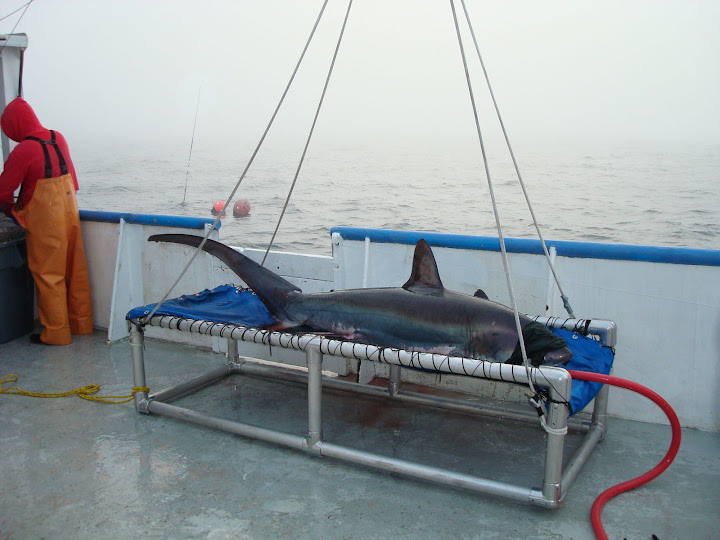
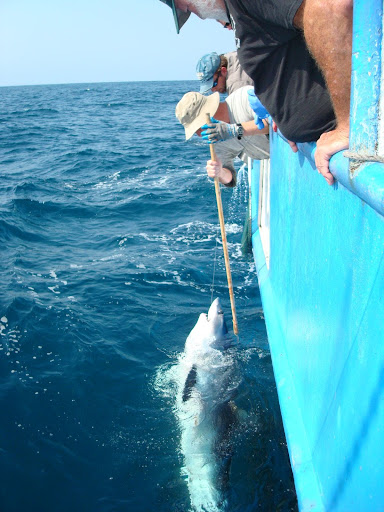
  The Dunkin Donuts cup clues you in to the fact that we are on the East coast; the shark being weighted is a common thresher. Lisa (that's her in the photo, Shaara and I stayed at her house while in RI and she taught us everything we know about the histology process described above) and other biologist at NMFS go to sport tournaments for sharks to collect samples every summer. Most of the fishermen let the biologist get samples and measurements from their sharks, which allows biologist to keep an eye on changing trends.
If I could design my ideal job it would be Lisa's, but on the west coast. She gets to work on sharks all the time, go out on boat's regularly for tagging & surveys and gets to see a lot of really cool stuff.
Shaara and I got to help out at a tournament on Martha's Vineyard, (and at this smaller one in RI). It was nothing short of a cultural experience. I would definitely do it again. One thing that was really reinforced while at the tournament is how miss-informed the general public can be. Don't believe what any activist group tells you until you look into it yourself, otherwise you aren't getting the whole story or may be told completely untrue things.
 This is a common thresher. The large organ out closest to the head is the liver. Sharks have a huge oily liver to help them maintain neutral buoyancy in the water.
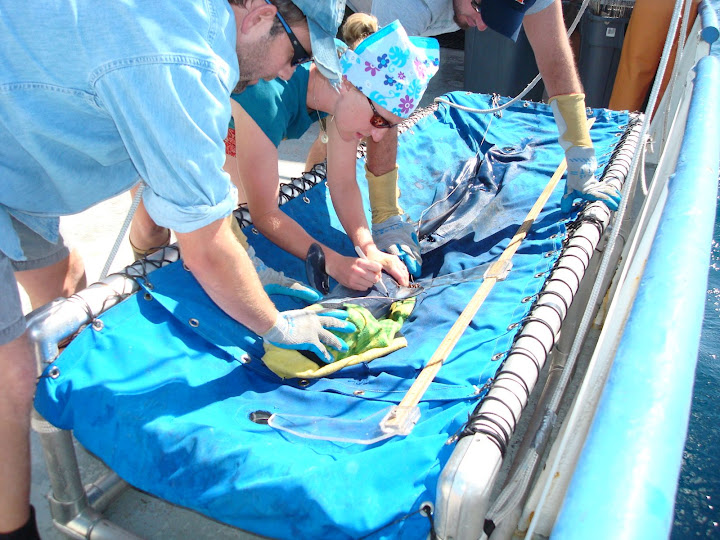
 This is the tournament at Martha's Vineyard. After biological info is collected the sharks are fillet, mako and common thresher are good tasting. We were really busy at this tournament moving from one animal to the next. The white bucket on the first table is what the liver is weighed in, often the liver fills the bucket.
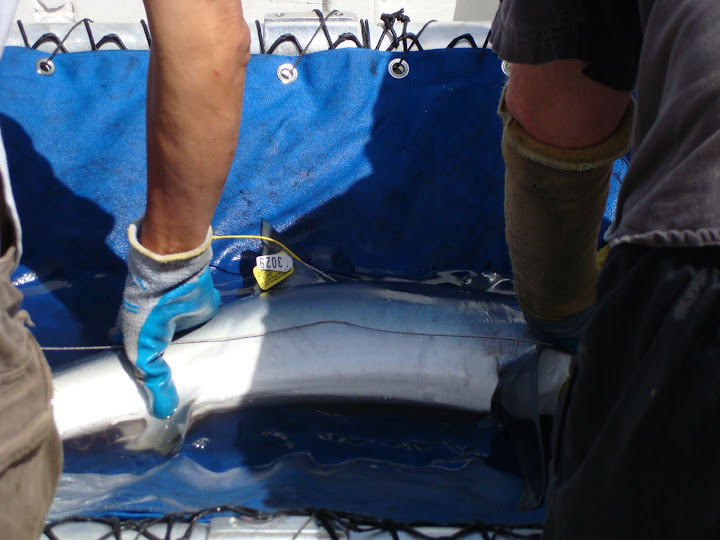
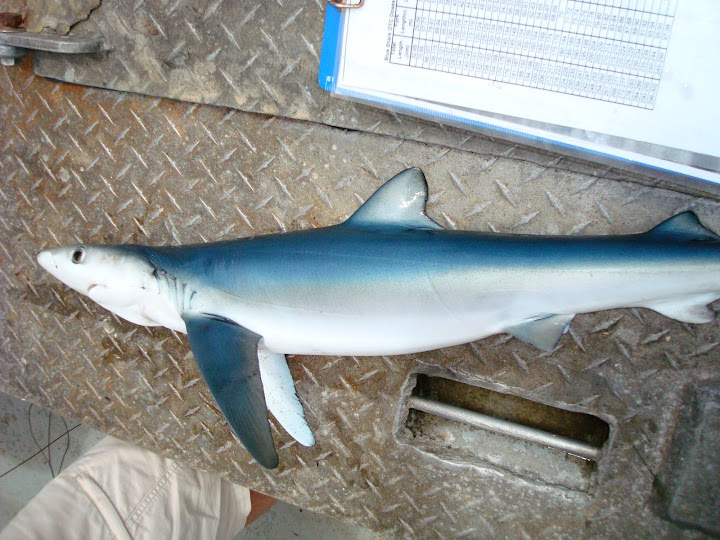
 All samples have to be properly labeled, this is a short-fin mako. Those teeth mean business.
 The tail!
 The crowds!
 The sunburn! The tournament on Martha's Vineyard has a minimum weight limit of 250lbs (this is above the legal limit) I can't say for sure, but I'm guessing this is one of the mako's that didn't make weight.
After three weeks we headed to Montreal for the American Elasmobranch Society meeting. We spent an afternoon in Boston to see some history before getting on the plane.
 The USS Constitution. If you are in Boston it is a must see. Especially if you are married to Louie. Yes, there was a thunderstorm for most of walking tour of the city.
 No, we were not dressed for rain.
The cannons took 12+ men to operate with 15 feet of recoil. The hull is three layers of wood thick giving the boat the nickname Ironside.
Once in Montreal I spent my time listening to the talks on sharks and at the bar. I got to meet a lot of the big names, other students, and learn about some interesting work being done. We had fun, and several good microbrews.
There is a nice park in the middle of Montreal I got to a few times. Our last day we spent exploring the city and hiking around the park.
 Shaara, Lewis and I at the viewpoint in the park. It is pretty flat around Montreal, we are standing on the tallest hill in sight.
 Tourist photo moment.
 On our exploring we did see some wildlife, and since we had the time and digital memory I had to take their pictures.








 Jasmine rocking the last pitch of After Six on lead. She has been working on her trad leading skills and comfort level. Look ma, only 4 pieces in 80 feet.
 Day two of climbing. Eric vs. Bush. Unfortunatley the bush won, eric was forced to go around but not before tearing out a few branches and throwing a sling around it for pro. Eric has also been working on his leading skills.
 Eric, making good time on lead...post bush.


